
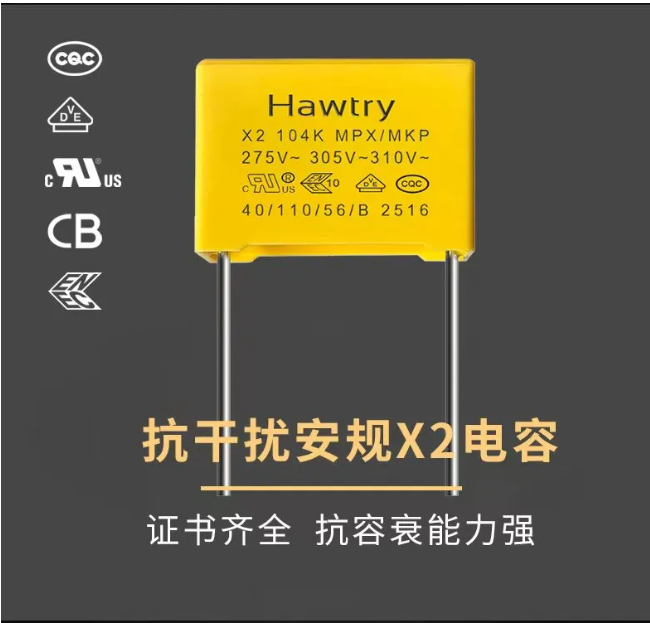
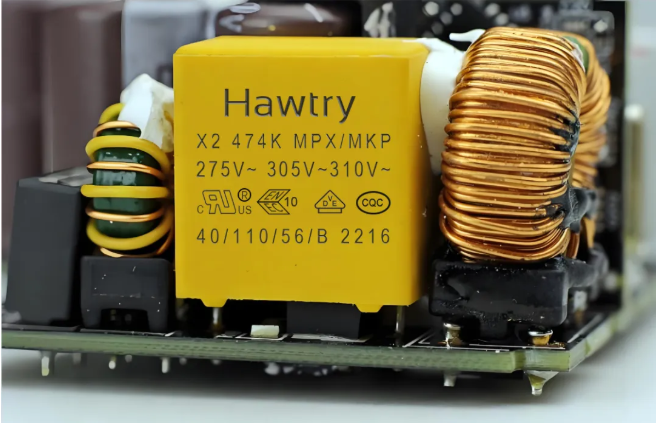
The reason why Hawtry X2 Safety Capacitors use μF values or three-digit capacitance codes on the component body, while CQC/VDE/UL safety certificates and test reports use pF as the capacitance unit, is because different application scenarios follow different industry standards.
The capacitance value is exactly the same; only the unit expression method differs.
The capacitance range of X2 film capacitors is typically concentrated between:
0.01μF ~ 2.2μF
In power supply design, purchasing, and production environments, engineers commonly use μF as the communication unit because it is intuitive and requires no conversion.
Examples:
0.1μF
0.47μF
1μF
Using μF directly allows engineers to quickly identify specifications during:
BOM preparation
Component selection
Prototype development
Production assembly
and reduces the risk of conversion errors.
Some manufacturers also use three-digit capacitance codes. The basic unit of this coding system is pF.
Example:
104
= 10 × 10⁴ pF
= 100,000pF
= 0.1μF
Both marking methods are widely used in the capacitor industry.
The three-digit capacitance code is more compact and suitable for smaller components.
Examples:
104
224
474
For some compact X2 capacitors, the digit code requires less printing space than direct μF marking, making it easier for automated production and laser printing.
Safety capacitor standards, including:
IEC 60384-14
Relevant national testing standards
require capacitance measurement results, type test reports, and certification documents to follow standardized engineering units.
Global certification organizations such as:
CQC
VDE
UL
ENEC
typically use pF in official certification documents.
The purpose is to ensure:
Consistent measurement references among laboratories worldwide
Unified factory inspection standards
Avoidance of disputes caused by unit conversion differences
X2 safety capacitors commonly have tolerances such as:
±10%
±20%
Using pF allows more precise evaluation of capacitance limits.
Example:
0.1μF = 100,000pF
For ±10% tolerance:
Acceptable range:
90,000pF ~ 110,000pF
If only 0.1μF is shown on a certificate, the detailed measurement range is less intuitive during:
Certification review
Factory audits
Incoming inspection
Professional measurement equipment, including:
LCR digital bridges
Safety capacitor test systems
Laboratory measurement instruments
typically use pF as the basic internal calculation unit.
The test report output is generated directly from the measured value, without additional conversion.
Example:
0.47μF
or
474
470,000pF
Conversion:
1μF = 1,000,000pF
Therefore:
0.47μF = 470,000pF
The electrical specification is completely identical.
Only the unit expression method differs according to the application scenario.
Recommended unit:
μF
Reason:
Easier for engineers to understand
Consistent with power supply design habits
Convenient for component selection
Example:
X2 Capacitor: 0.22μF ±10% 275VAC
Recommended unit:
pF
Reason:
Required by certification documentation practices
Based on international measurement standards
Not a parameter difference
Example:
Certified Capacitance: 220,000pF
Simply provide the conversion formula:
1μF = 1,000,000pF
Example:
0.22μF = 220,000pF
The product specification is identical.
For Hawtry X2 Safety Capacitors:
Product marking: μF or digit code → convenient for engineers, purchasing, and production
Datasheets: μF with pF conversion → clear technical communication
Safety certificates: pF → unified international certification format
This difference is a normal industry practice and does not represent any inconsistency in product specifications.

Phone
24/7 Customer Service Hotline

Your email will be replied to promptly.
Message
Top